

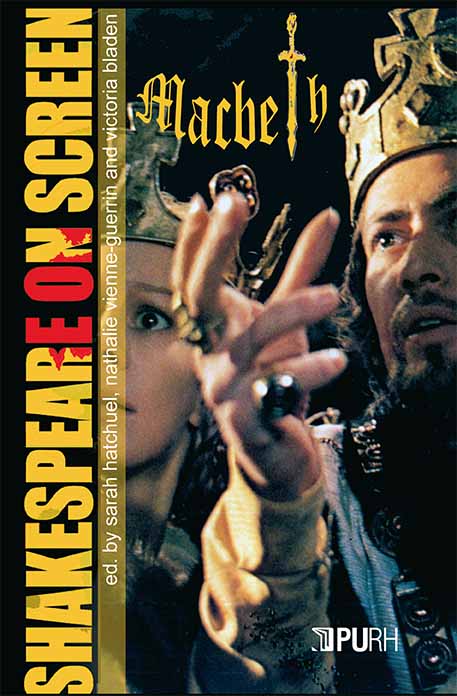
Shakespeare on screen
Trouver ce livre chez des libraires en ligne ou en libre accès
Présentation
<p> This addition to the Shakespeare on Screen series reveals the remarkable presence of Macbeth in the global Shakespearean screenscape. What is it about Macbeth that is capable of extending beyond Scottish contexts and speaking globally, locally and "glocally"? Does the extensive adaptive reframing ofMacbeth suggest the paradoxical irrelevance of the original play? After examining the evident topic of the supernatural elements—the witches and the ghost—in the films, the essays move from a revisitation of the well-known American screen versions, to an analysis of more recent Anglophone productions and to world cinema (Asia, France, South Africa, India, Japan, etc.). Questions of lineage and progeny are broached, then extended into the wider issues of gender. Finally, ballet remediations, filmic appropriations, citations and <em>mises-en-abyme</em> of Macbeth are examined, and the book ends with an analysis of a Macbeth script that never reached the screen.</p>
Table des matières
Victoria Bladen, Sarah Hatchuel, Nathalie Vienne-Guerrin – Préface.
Dominique Goy-Blanquet – Phantom of the Cinema: Macbeth's Ghosts in the Flesh;
Warren Chernaik – "Instruments of Darkness": Witches and the Supernatural in Four Versions of Macbeth;
Pierre Kapitaniak – Witches and Ghosts in Modern Times Lost? How to Negotiate the Supernatural in Modern Adaptations of Macbeth;
Susan Gushee O'Malley – Macbeth's Witches: Nurses, Waitresses, Feminists, Punk Gore Groupies;
Victoria Bladen – Weird Space in Macbeth on Screen;
Pascale Drouet – "Look how our partner's rapt": Externalizing Rapture in Orson Welles's Macbeth (1948-1950);
Charles R. Forker – Symbolic and Thematic Impoverishment in Roman Polanski's Macbeth;
Boika Sokolova – "Horrible imaginings": Rupert Goold's Film Adaptation, a Macbeth for the Twenty-First Century;
Adele Seeff – Shakespeare in Mzansi;
Sarah Hatchuel, Nathalie Vienne-Guerrin – Claude Barma’s Macbeth (1959): Shakespeare and the hybridity of the French "dramatique";
Anne-Marie Costantini-Cornede – ". . . [M]ethought/ The wood began to move" (5.5.32-33) or Whatever Happened to Witches and Woods in Akira Kurosawa’s Throne of Blood (1957), Alexander Abela’s Makibefo (1999) and Mark Brozel’s Macbeth (2005): Film style or the Poetics of Displacement;
William C. Carroll – Fleance in the Final Scene of Macbeth: The Return of the Repressed;
Andrew Fleck – "A Barren Sceptre" (3.1.63): Generation, Generations, and Destiny in Maqbool and Global Adaptations of Macbeth;
Gayle Allan – Home Sweet Home: Visual Representation of Domestic Spaces in Macbeth;
Courtney Lehmann – Happily Never After? Women Filmmakers and the Tragedy of Macbeth;
Jennifer Drouin – “Get a Look at Your Wife’s Beautiful Cones": Lady Macbeth’s Stone Butch Blues and Rural Second-Wave Feminism in Scotland, P.A.
Elinor Parsons – “Struts and frets”: Physical Eloquence in Vladimir Vasiliev’s Macbeth;
Patricia Dorval – Macbeth in Andre Barsacq’s Le Rideau rouge (1952): Mise en Abyme and Acoustic Porousness;
Sarah Hatchuel, Nathalie Vienne-Guerrin – “Is this an umbrella which I see before me?”: Columbo goes to Scotland Yard;
Jennifer Barnes – Art not without Ambition: Stardom, Selfhood and Laurence Olivier’s unmade Macbeth;
José Ramón Diaz Fernandez – Macbeth on Screen: An Annotated Filmo-Bibliography.